

Reviews are one of the few parts of local search a business can influence directly — and one of the easiest to get wrong. Google’s rules on how you ask are stricter than most owners realise, and breaking them risks the reviews you already have. Here is how to ask properly.
Most businesses do one of two things: never ask at all, or ask in a way that breaks Google’s policies. Both cost you. The good news is that the rules are short and public.
What Google encourages
Asking is allowed and expected. Google’s own advice is to “Remind customers to leave reviews: To leave reviews, you can ask customers to visit a Google link or scan a QR code.”
You can find your review link in your Business Profile and share it by text, email, receipt, invoice or a QR code on a van or counter. The easier it is to reach, the more people follow through.
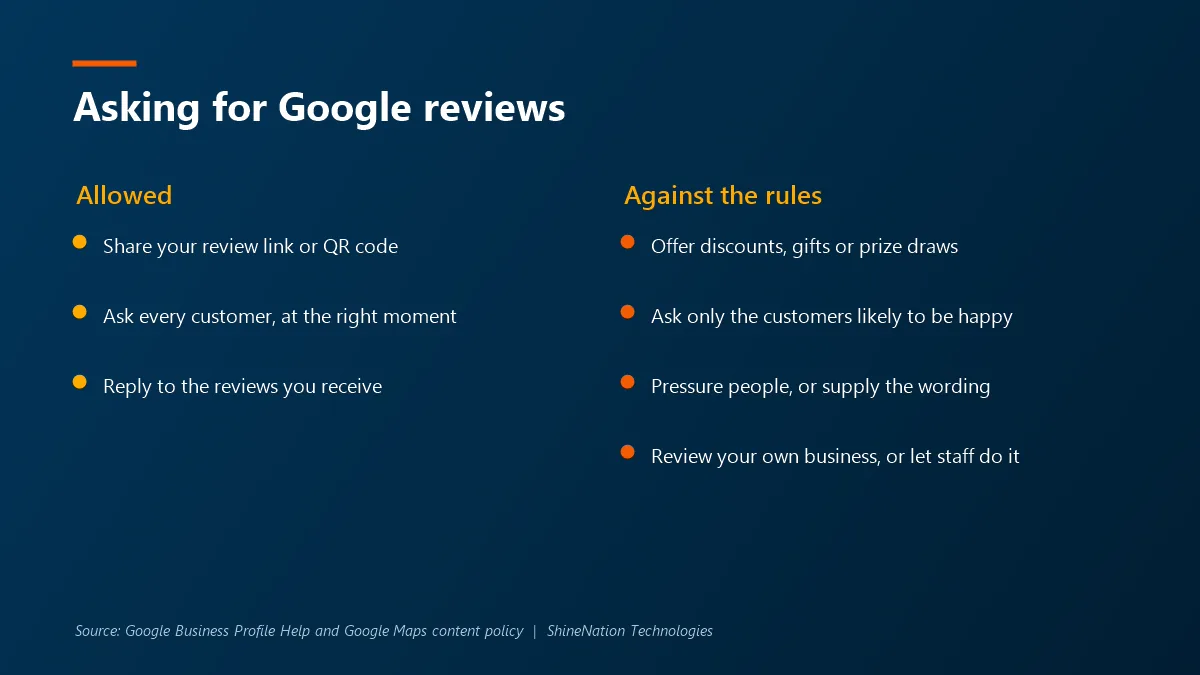
What is against the rules
Offering anything in return
This is the one that catches good businesses out. Google states that “Offering incentives, like free or discounted goods or services, in exchange for customers to post reviews, change reviews, or remove negative reviews is considered fake & misleading content and is strictly prohibited.” Its content policy is equally direct about “Reviews or ratings that have been paid for, directly or in kind.”
No discounts, no free drinks, no prize draws. Not even for “honest” reviews.
Asking only the customers you expect to be happy
Filtering people before you ask — sometimes called review gating — is not allowed. Google’s policy says merchants “should not…selectively solicit positive reviews from customers.” Ask everyone, or ask no one.
Pressuring people, or telling them what to write
The same policy says merchants “should not require or pressure users to leave ratings or write reviews while on the premises, nor should they request that specific content be included.” Handing someone your phone at the counter and watching them type is exactly what this rule is about.
Reviews from people connected to the business
Google treats a conflict of interest as a policy breach, and says one “may include current or former employment, a contractual or consultory relationship, or other professional or personal affiliations.” So staff, family and suppliers should not review the business, and neither should you.
A process that works and stays inside the rules
- Ask at the right moment — when the work is finished and the customer is visibly pleased, not weeks later.
- Ask every customer, not a chosen few.
- Send the direct link by text or email straight after the job, with one sentence saying why it helps.
- Ask once, and follow up once. More than that is pestering.
- Never offer anything in return — not even a thank-you discount.
- Reply to what arrives.
What to say
Keep it short and human. Something like: “Thanks again for your business today. If you have a minute, a quick Google review really helps other people in Racine find us: [link]. Either way, we appreciate it.”
No script for the customer, no mention of stars, no hint about what to write.
Bad reviews are part of it
Google’s guidance is that “Honest and balanced reviews can help potential customers decide. A mix of positive and negative feedback often feels more trustworthy.” A profile with nothing but five stars reads as suspicious.
When replying, Google suggests concentrating on reviews where you can share a helpful update or answer a question rather than sending everyone the same response. Answer a complaint factually, say what you have changed, and leave the argument alone. The reply is written for the next person reading, not for the reviewer.
Where reviews fit in the bigger picture
Reviews feed into how well known and well regarded a business looks, which Google calls prominence — one of the three factors behind local results. They sit alongside a complete profile and consistent business details, covered in our local SEO checklist for Racine businesses.
The effect can show up in revenue as well as rankings: a Harvard Business School study of Yelp ratings found that a one-star increase meant 5 to 9 per cent more revenue for independent restaurants.
Want a review process set up properly?
We can set up your review link, QR code and follow-up messages so asking becomes routine and stays inside Google’s rules — and show you how to reply to the difficult ones.