

Every local business is told to build a page for each town it serves. Done well, those pages win work. Done the usual way — the same paragraph with the town name swapped — they fall foul of Google’s spam policies. Here is the line between the two, in Google’s own words.
What Google actually prohibits
Google’s spam policies name this directly. “Doorway abuse is when sites or pages are created to rank for specific, similar search queries.” Among the examples it gives:
- “Having multiple domain names or pages targeted at specific regions or cities that funnel users to one page.”
- “Creating substantially similar pages that are closer to search results than a clearly defined, browseable hierarchy.”
- “Generating pages to funnel visitors into the actual usable or relevant portion of a site.”
There is a second policy that catches the modern version of this. Google says “Scaled content abuse is when many pages are generated for the primary purpose of manipulating search rankings and not helping users”, and that this applies to large amounts of unoriginal content “no matter how it’s created” — which includes pages written by AI, spun from a template, or assembled from other sites.
So twenty pages reading “plumber in [town]”, identical but for the name, are exactly what both policies describe.
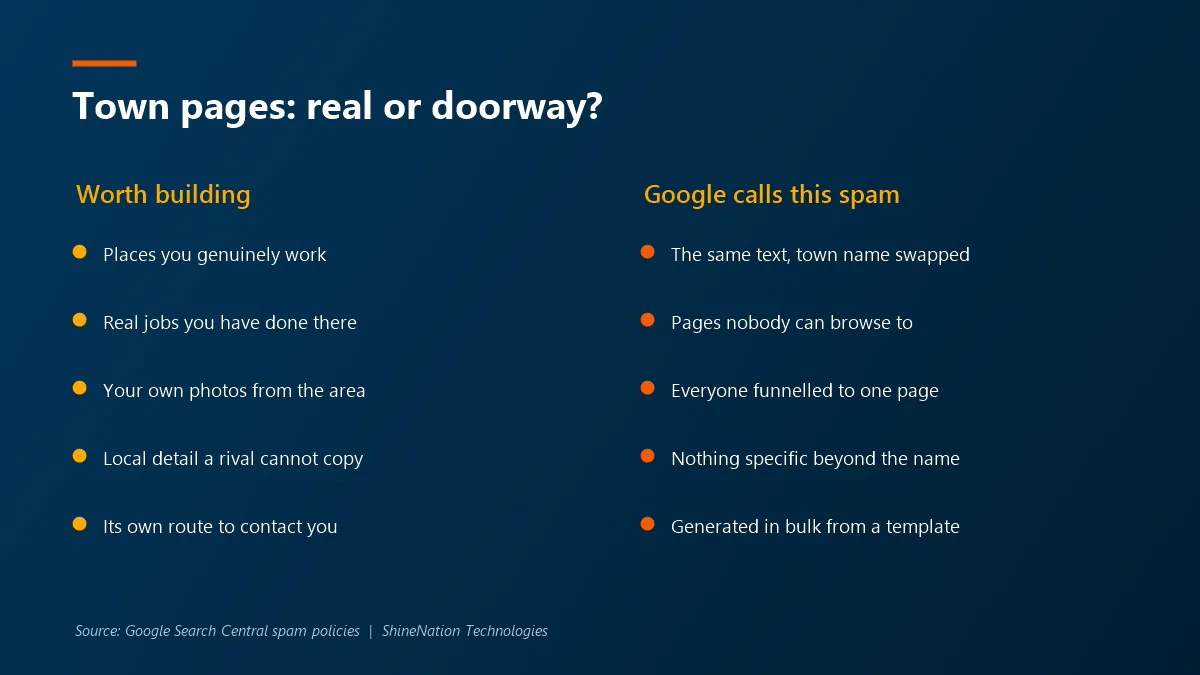
The test that settles it
Ask one question about each town page: would this page exist, and be worth reading, if search engines did not?
If the answer is yes — because you really do work in that town, and the page says something true and specific about working there — it isn’t a doorway page. If the only reason it exists is to catch a search, it is.
How to build local pages worth having
- Only build pages for places you genuinely serve. If you wouldn’t drive there tomorrow, don’t write the page.
- Name real jobs you have done there, with the customer’s permission — the type of property, the problem, the solution. This is the part competitors can’t copy.
- Write what is different about working there: older housing stock, a particular industry, travel times, parking, the types of enquiry you usually get.
- Use your own photographs from work in that area.
- Answer local questions — how quickly you can get there, which neighbouring areas are covered, how call-outs are charged.
- Give each page a real route to contact you, not a link that dumps everyone on the same generic form.
- Fewer, better pages. Three substantial town pages beat fifteen thin ones, and carry no risk.
Signs you have built doorway pages without meaning to
- You could swap the town names between pages and nobody would notice.
- The pages are not linked from anywhere a human would browse.
- Every page pushes to the same contact page with the same words.
- You cannot say anything specific about the town beyond its name and distance.
- They were generated in bulk, by a tool or a template.
If that describes your site, the fix is not to delete everything in a panic. Merge the thin pages into one honest “areas we cover” page, and rebuild only the two or three places where you have real work and real detail to show.
What this has to do with ranking
Local results turn on relevance, distance and prominence. A genuine town page helps with relevance, because it gives Google something real to match a local search against. A template farm helps with none of them, and risks the rest of the site. The rest of the groundwork — profile, listings, reviews — is in our local SEO checklist.
Not sure if your local pages are safe?
Send us the URLs. We’ll tell you honestly which pages are doing work, which are thin, and what each one needs to be worth keeping.