

A service page has two jobs: get found for the thing it describes, and turn the person who finds it into an enquiry. Most pages on small business websites do neither, because they are written as a brochure. Here is what a service page needs, and what Google says about judging it.
Start with one page per service
If you offer six services, one page listing all six matches a specific search far less precisely than six pages, each explaining one thing properly. The same logic applies to anything a customer would search for on its own — emergency work, installations, maintenance contracts.
The limit is honesty: build a page only where you genuinely have something to say about that service. Pages created mainly to catch searches are what Google calls search-engine-first content, and it asks directly: “Is the content primarily made to attract visits from search engines?”
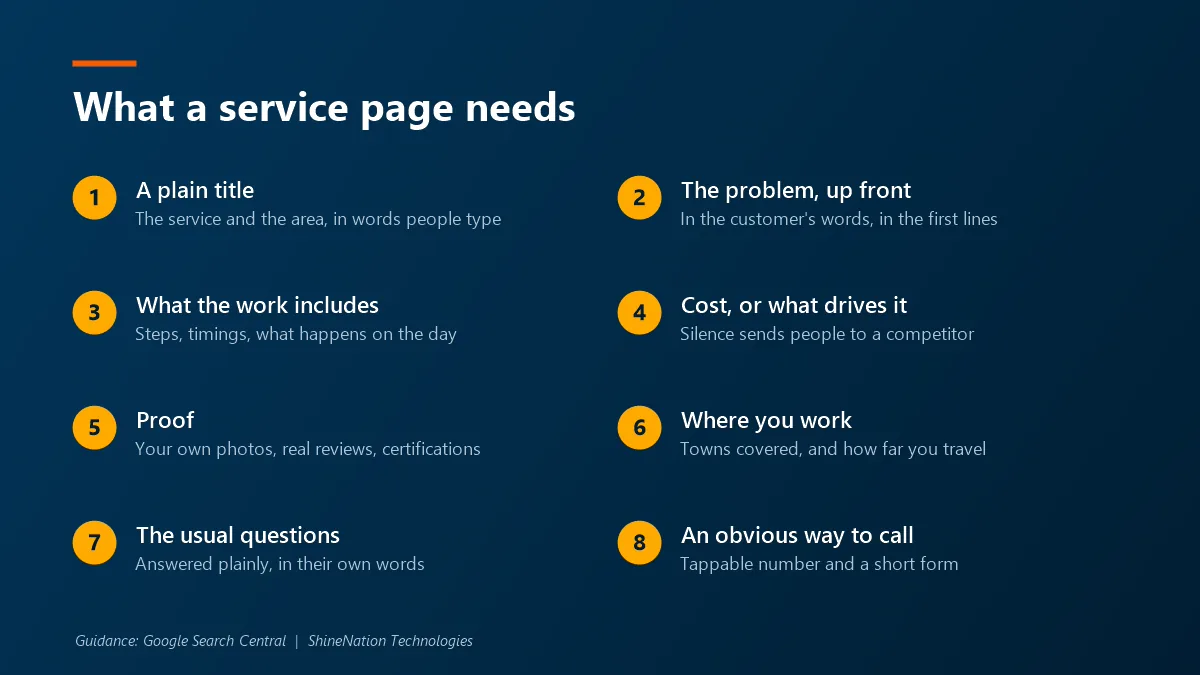
What the page needs, in order
- A plain title naming the service and the area. Not “Solutions”. If someone would type it, use it.
- The problem in the customer’s words, in the first paragraph, so they know they’re in the right place within seconds.
- What the work actually includes — the steps, what you bring, how long it takes, what happens on the day.
- What it costs, or what drives the cost. If you can’t publish prices, explain the factors and the typical range of work. Saying nothing is the most common reason people leave for a competitor.
- Proof. Photographs of your own work, real reviews, the qualifications or certifications you hold. Only things you can evidence.
- Where you work — the towns, and how far you travel.
- The questions you get asked every week, answered plainly. These are usually the exact phrases people search.
- An obvious way to make contact: a tappable phone number and a short form, repeated at the end of the page.
What Google says it is looking for
Google’s guidance on creating helpful content is a list of questions worth holding your page against. Among them:
- “Does the content provide original information, reporting, research, or analysis?”
- “Does your content clearly demonstrate first-hand expertise and a depth of knowledge?”
- “Is this content written or reviewed by an expert or enthusiast who demonstrably knows the topic well?”
- “Is this the sort of page you’d want to bookmark, share with a friend, or recommend?”
- And the warning signs: “Are you mainly summarizing what others have to say without adding much value?” and “Are you using extensive automation to produce content on many topics?”
Google describes what its systems try to identify as “experience, expertise, authoritativeness, and trustworthiness, or what we call E-E-A-T”, with trust the most important part, and says quality depends on “effort,” “originality,” “talent or skill,” and “accuracy.”
For a tradesperson or a manufacturer, that is good news: first-hand experience is the one thing you have that a content farm doesn’t. Photographs of your own jobs, the problems you actually meet in local properties, the mistakes you see — none of it can be copied.
Write it so it can be scanned
Research on reading behaviour is consistent: most visitors scan rather than read. Short paragraphs, honest headings, lists for anything that is a list, and no promotional padding. Our summary of the original scanning research covers why plain writing measures better than marketing language.
Before you publish, check these
- Does the first line say what the service is and where you do it?
- Could a stranger work out roughly what it costs, or what decides the cost?
- Is there proof on the page that you have actually done this work?
- Is the phone number tappable on a phone, without scrolling?
- Does the page load quickly? Test it with PageSpeed Insights.
- Is every claim on it true and provable?
Want your service pages rebuilt properly?
We can rework your main service pages so each one covers a single service, answers the real questions, and gives people an obvious way to get in touch — using only what is true about your business.