

If you own a business website, you get the emails: guest post opportunities, link packages, “we have 500 high DA sites”. They are cheap, they are easy, and Google’s published policies describe almost exactly what they sell. Here is what the rules actually say, and what to do instead.
What Google counts as link spam
The definition in Google’s spam policies is broad and simple: link spam is “creating links to or from a site primarily for the purpose of manipulating search rankings.”
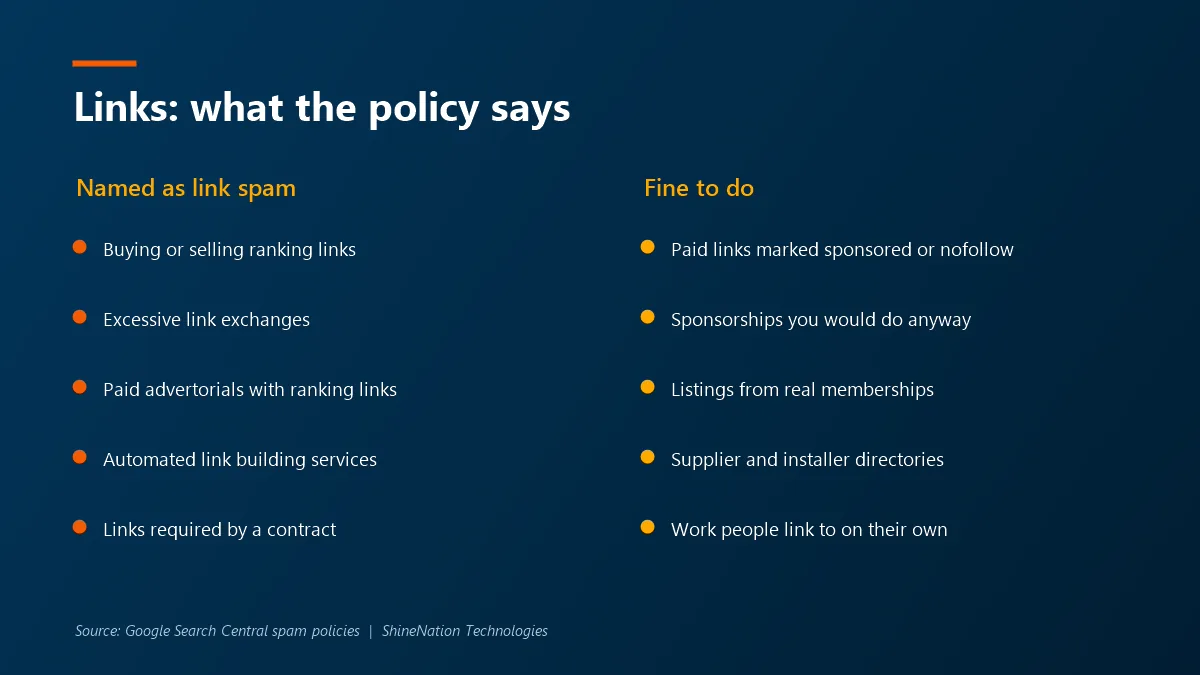
The examples it lists cover most of what gets sold to small businesses:
- “Buying or selling links for ranking purposes.”
- “Excessive link exchanges” and “partner pages exclusively for the sake of cross-linking”.
- “Advertorials or native advertising where payment is received for articles that include links that pass ranking credit.” That is the paid guest post, named directly.
- “Using automated programs or services to create links to your site.”
- “Requiring a link as part of a Terms of Service, contract, or similar arrangement.”
Paying for links is not automatically against the rules
This is the part people miss. Google is explicit that buying and selling links for advertising or sponsorship is normal business, and not a violation “as long as they are qualified with a `rel="nofollow"` or `rel="sponsored"` attribute value” on the link.
So sponsoring a local junior football team and getting a link from the club’s website is fine. Paying a blog to publish an article with a plain ranking link is not. The difference is whether the link is marked as paid.
Worth knowing if you ever sponsor anything: you can ask the recipient to mark the link, and a club or charity will usually be happy to. The visibility and the local goodwill still count for something, even without ranking credit.
What happens if you do it anyway
Google’s statement is short: “Sites that violate our policies may rank lower in results or not appear in results at all”, and it “may act against any type of spam practices we detect.”
For a local business, the asymmetry is what matters. A link package costs a few hundred dollars. Disappearing from search for the term your customers use costs you the business. Paying for a risk you don’t control, on an asset you depend on, is a bad trade at any price.
What to do instead
Earned links are slower, and they are the only ones you keep:
- Local organisations you genuinely belong to — chambers of commerce, trade associations, supplier directories. These are real relationships with real listings.
- Sponsorships you were going to do anyway. Teams, events, school fundraisers. Ask for the mention; don’t buy the ranking.
- Being useful to local media. A local news site needs people who know things. Being quotable is a long game that pays.
- Suppliers and manufacturers who list approved installers or stockists.
- Work worth linking to. A genuinely useful local guide earns links from people you never contacted.
How to judge the next email you get
- Would this link exist if search engines didn’t? If not, it is what the policy describes.
- Is money changing hands for a ranking link? Then it needs the sponsored or nofollow mark — and if it carries that mark, ask yourself what you are actually buying.
- Is the number suspiciously large? Hundreds of links in a month is automation, which is named in the policy.
- Would you be happy telling Google exactly how you got the link? That question settles most cases.
The honest summary is that link building for a local business is slow, manual and relationship-based. It looks much less impressive than a spreadsheet of 500 links — and it is still there in two years.
Had an offer you’re unsure about?
Forward it to us. We’ll tell you plainly whether it falls under Google’s link spam policy, and what we’d do with the same budget instead.