

You pay for the click either way. The question is where it lands. Sending paid traffic to your homepage is the most common and most expensive habit in small business advertising — here is when a dedicated landing page is worth building, and when it isn’t.
Why the homepage usually loses
A homepage has to serve everyone: new customers, existing ones, people looking for your phone number, people looking for a job. A landing page serves one person — the one who just searched for the thing your ad offered.
When somebody searches “emergency boiler repair Racine”, clicks an ad promising exactly that, and arrives on a homepage listing six services, a careers link and a company history, they have to find the relevant part themselves. Some do. Many go back to the search results.
What Google measures
Google’s Quality Score has three components, and one of them is about this directly:
- Expected clickthrough rate — “The likelihood that your ad will be clicked when shown.”
- Ad relevance — “How closely your ad matches the intent behind a user’s search.”
- Landing page experience — “How relevant and useful your landing page is to people who click your ad.”
Each is graded as above average, average or below average, compared with other advertisers whose ads showed for the same searches over the previous 90 days.
One correction worth making, because it gets repeated endlessly: Google states that “Quality Score is not an input in the ad auction.” It is a diagnostic tool, not a dial. Treat a below-average landing page experience as a signal that your page doesn’t match what people expected — which costs you enquiries regardless of what it does to the auction.
When to build a landing page
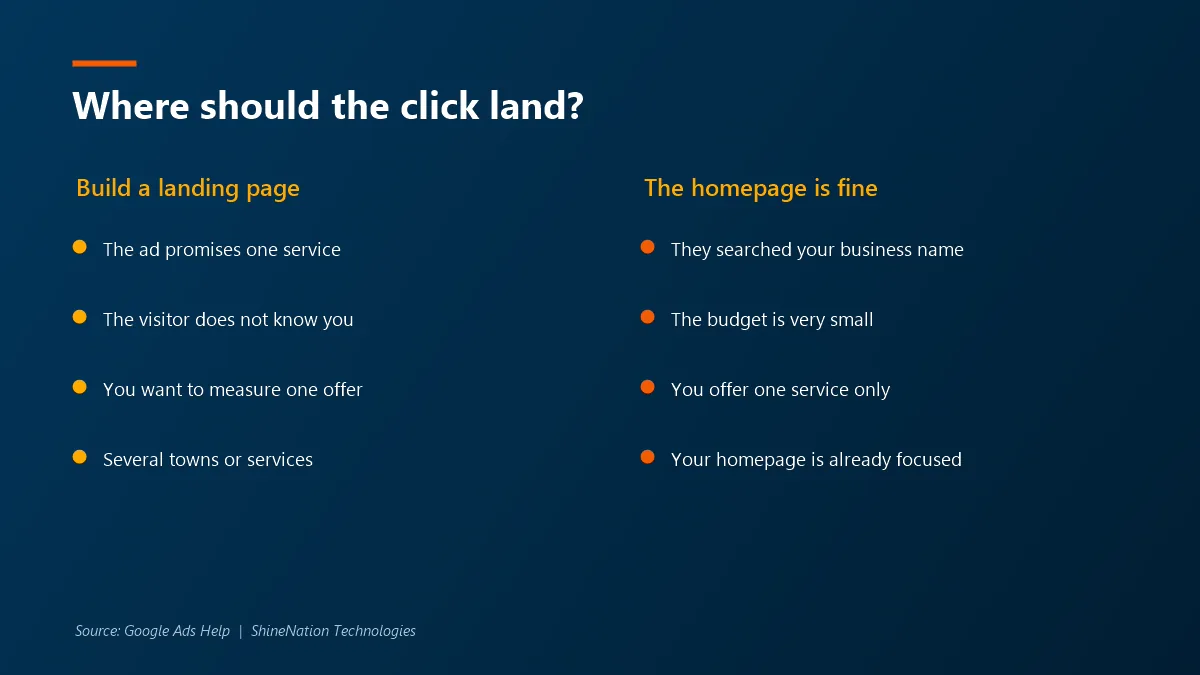
- The ad promises one specific service. The page should repeat that promise in its first line.
- The visitor doesn’t know you. They need reassurance, not a company tour.
- You want to measure one thing. One page, one offer, one conversion action — results you can actually read.
- You serve several towns or services and the differences matter to the customer.
When the homepage is fine
- Someone searched your business name. They want you, not a sales page.
- Your budget is very small and building a page would eat the spend. Improve the service page instead.
- Your homepage already does one job well — some single-service businesses genuinely have a homepage that is a landing page.
What the page needs to contain
- The promise from the ad, in the first line.
- Where you work and how fast you can get there.
- What the work involves, and what drives the price.
- Proof — your own photos, real reviews.
- A tappable phone number and a short form, visible without scrolling.
- Nothing else. No navigation maze, no six other services competing for the click.
It also has to load fast and work on a phone, because most of these clicks are mobile. Our guide to reading PageSpeed Insights covers how to check that, and the structure of a page that converts is in what a service page needs.
The test
Click your own ad on your phone. Count the seconds before you can tell that this business does the exact thing you searched for. If it is more than two or three, the landing page is the problem — not the bid.
Paying for clicks that bounce?
We can look at where your ads currently send people and tell you whether a dedicated page is worth building for your budget — or whether fixing the existing page would do.